
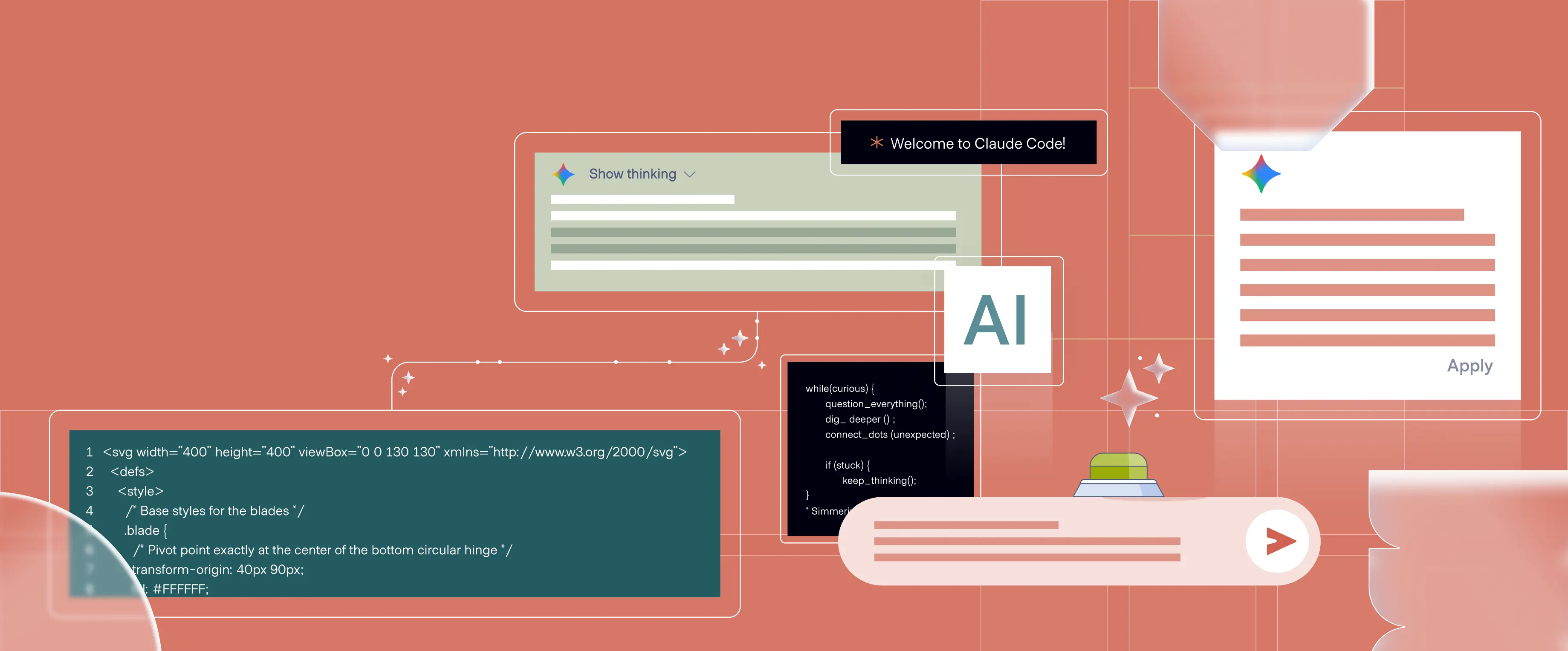

This month at Polar: a complete website redesign for Corbel that brings AI-powered sales to life through 3D animation and strategic simplicity, a homepage evolution for Revenium built on the grid system we've been refining since day one, and a look at how Gemini 3.1's SVG animation capabilities are changing our approach to web motion design.
We're also excited to announce that we're now officially certified Webflow partners. After years of building hundreds of webpages on the platform, from early-stage startups to scaling companies, this certification reflects both our technical expertise and our commitment to delivering best-in-class Webflow experiences. It means direct access to Webflow's product team, early feature releases, and deeper collaboration with the platform shaping how modern startups build for the web. For our clients, it's another layer of confidence that their website is built by a team that doesn't just use Webflow - we master it.
From homepage redesigns to motion systems and platform partnerships, March was about refining the craft and expanding what's possible.

We just launched a complete redesign and rebuild for Corbel, an AI-powered sales platform built for complex equipment manufacturers, dealers, and distributors.
Selling capital equipment means navigating technical specs, financing options, product configurations, and long sales cycles. Corbel simplifies that entire process with AI-driven quoting, embedded financing, and channel visibility. Our job was to make a complex platform feel clear, modern, and immediately credible.
The hero section sets the tone with a custom 3D animation that brings Corbel's product to life. Instead of generic imagery or stock visuals, we designed a stylized industrial machinery scene with Corbel's redacted UI interface layered on top. The animation positions the platform as both technically sophisticated and visually distinct, establishing authority in a space dominated by legacy tools and outdated sales processes.
For "The Solution" section, we transformed Corbel's core product features into a series of engaging, scroll-triggered animations. Each feature—AI Sales Assistant, Product Configurator, Smart Upsells, Embedded Financing, and Dealer Visibility—is presented with motion and clarity, breaking down what could feel overwhelming into digestible, visual moments. The animations don't just explain features; they demonstrate value, showing how each piece of the platform fits into the sales process.
Visually, the site balances clean layouts with dynamic energy. Light green—Corbel's signature color—punctuates key sections, CTAs, and interactive elements, creating a consistent thread throughout the experience. The design feels modern and confident without overcomplicating the message, a critical balance for a product selling into an industry that values both innovation and reliability.
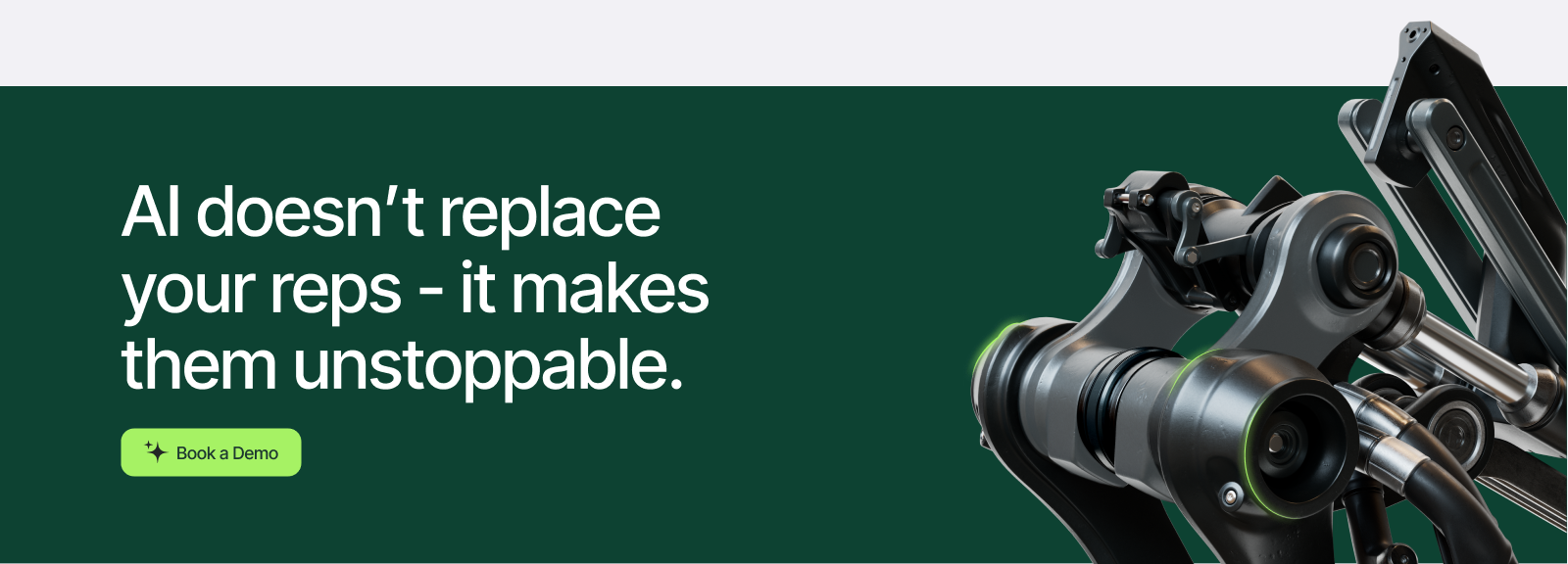
The result is a website that positions Corbel not just as another SaaS tool, but as the modern revenue platform capital equipment companies have been waiting for.


If you've ever worked on a frontend team, you know the drill: the design system in Figma looks pristine, but the moment it hits the codebase, things start to drift. Tokens get renamed, spacing gets eyeballed, and your single source of truth splinters.
For our client Able's design system, we built a continuous, bi-directional workflow between Figma and production HTML using Claude Code's MCP toolchain that killed the manual handoff for good.
In our latest article, we break down the exact 5-step autonomous workflow: extracting design context directly from Figma, mapping tokens with zero divergence, building production HTML with strict variable enforcement, running visual validation loops that self-correct spacing and alignment, and pushing validated components back to Figma to keep both environments in sync.
The secret? A strict 1:1 token mapping where every Figma variable corresponds exactly to a CSS custom property. The result: 8 production files shipped in single sessions, zero hardcoded values, perfect convergence within 3 iterations.
When design and code speak the same language, the handoff gap doesn't just shrink - it disappears.

Since we started working with Revenium last year, we've been steadily evolving their visual identity - refining the character system, building out brand assets, and developing a design language that balances technical sophistication with clarity. This month, we tackled one of the most critical pieces: the homepage.
Revenium is an AI Economic Control System built for engineering and finance leaders navigating the Agentic Economy. It answers the questions most observability and FinOps tools can't: Which AI decisions are profitable? What's the real cost per customer, per feature, per workflow? And how do you stop unprofitable usage before it destroys margins?
The challenge was communicating that level of strategic depth while keeping the experience approachable and visually compelling. The redesigned homepage is built around the grid system we developed as part of Revenium's visual language—a structured framework that brings order to complexity and reinforces the platform's role as a control system.
The hero section leads with the product itself, immediately showing users what economic observability looks like in practice. Instead of vague promises or conceptual illustrations, visitors see the dashboard, the data, and the clarity Revenium delivers.
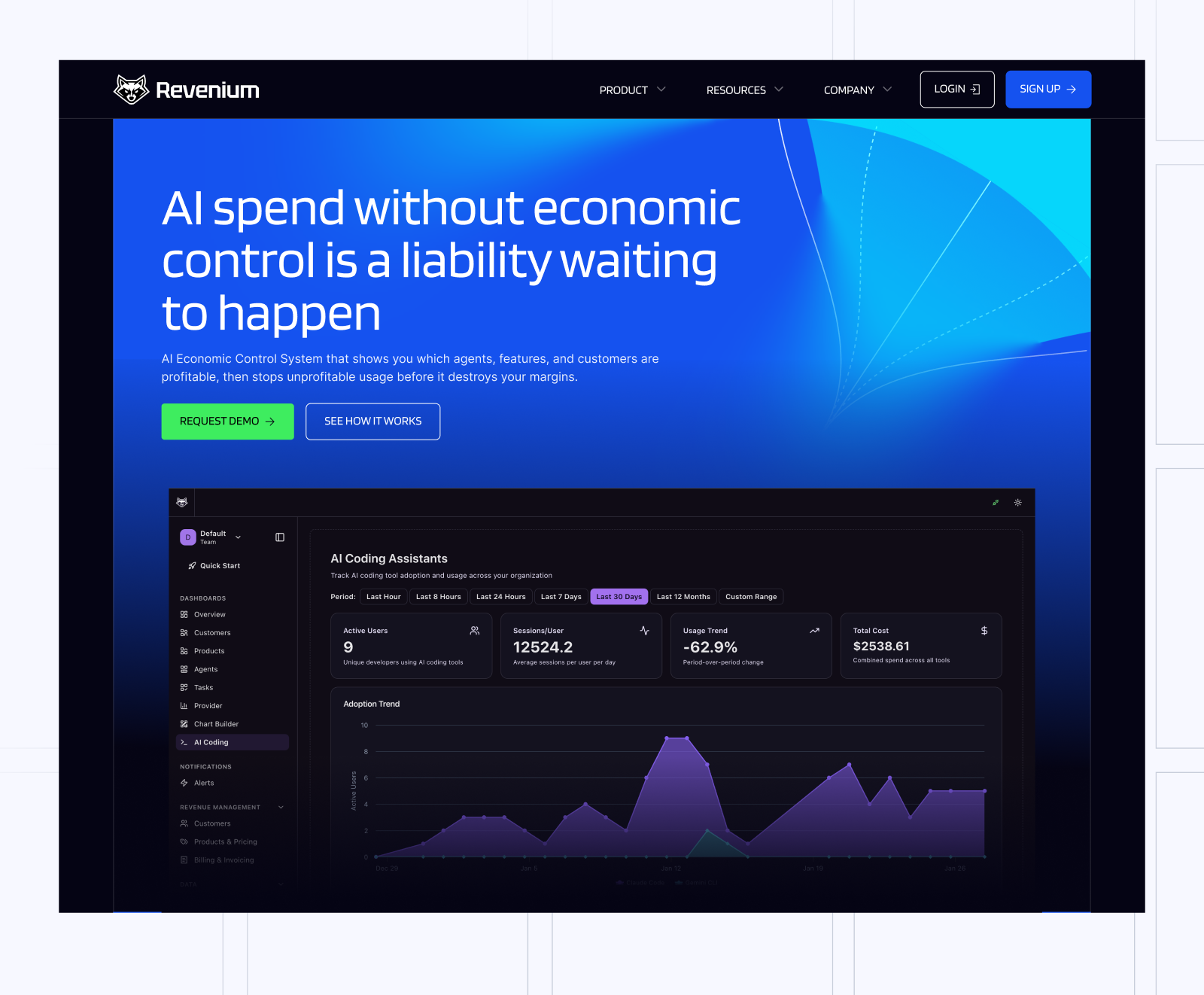
Throughout the site, we used light blue as a signature accent, punctuating key sections and CTAs while maintaining the dark, technical aesthetic that speaks to Revenium's engineering and finance audiences. The contrast creates visual rhythm without compromising the serious, authoritative tone the brand requires.
For the product features - Economic Observability, Economic Control, and Economic Intelligence - we designed a series of redacted UI illustrations that simplify what could easily feel overwhelming. Each illustration highlights the core value of the feature without getting lost in technical density, making the platform's capabilities immediately digestible.
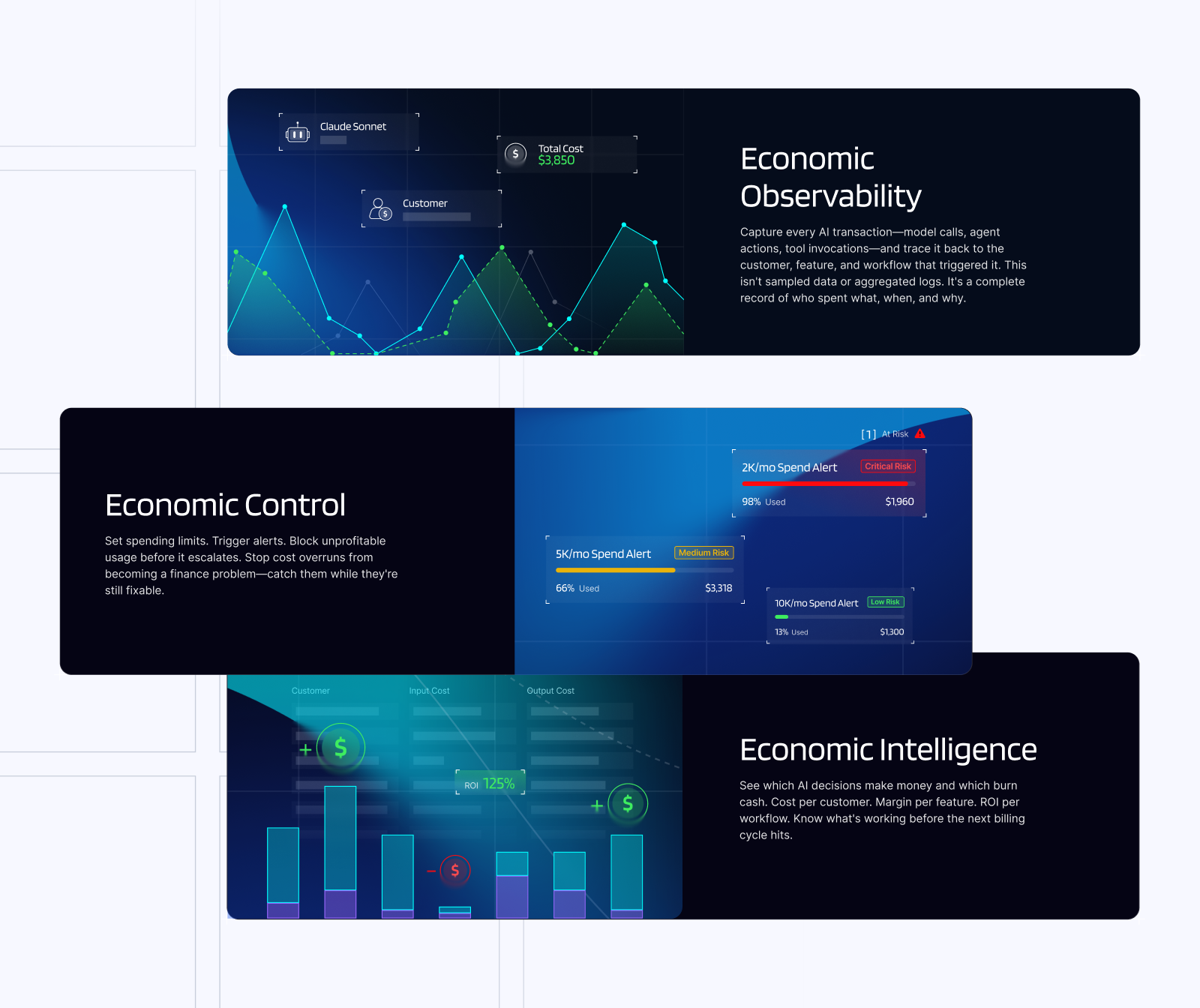
This homepage positions Revenium not just as another monitoring tool, but as the economic control layer that companies building in the AI space didn't know they needed - until now.
We're excited to keep building with Revenium as they scale. More pages, deeper storytelling, and continued evolution of a brand system designed to grow with the platform.

Google's Gemini 3.1 release brings a capability we've been waiting for: native SVG animation generation. It's a practical shift in how we can approach motion design for the web.
SVG animations have always been powerful for websites. They're scalable, performant, lightweight, and work seamlessly across devices. The model can generate complete, animatable SVG code from natural language prompts. More importantly, it understands timing, easing, sequencing, and visual hierarchy well enough to produce animations that feel intentional rather than arbitrary. For web design teams, this means faster prototyping, easier iteration, and the ability to test motion concepts without committing hours to production before knowing if the direction works.

Where we see this fitting into our process:
For hero animations and scroll-triggered interactions, Gemini 3.1 lets us rapidly explore multiple motion concepts during the design phase. Instead of describing an idea to an animator or settling for static mockups, we can generate working prototypes, test them in-browser, and refine from there.
For icon systems and micro-interactions, the ability to quickly animate brand elements - loaders, state changes, hover effects - means we can add polish and personality to interactions that would otherwise stay static due to time constraints.
For complex data visualizations, Gemini 3.1 can handle animated charts, graphs, and diagrams that respond to user interaction or scroll position, making technical content more engaging without requiring custom JavaScript libraries.
The limitations matter, too.
This isn't replacing motion designers. Gemini 3.1 produces solid starting points, but the nuance - brand-specific timing curves, emotional pacing, contextual appropriateness - still requires human refinement. The model also struggles with highly complex, multi-layered animations where precise choreography between dozens of elements is critical.
But as a tool for exploration, iteration, and production of straightforward motion, it's immediately useful. We're already incorporating it into client projects where SVG animation can enhance the experience without adding bloat or complexity to the stack.



.webp)